
PROLOGUE
In order to eat this layered cake, first I need to peel a pretty big onion. I worked at The Durango Herald from 2004 to 2015, and I was the sports editor in 2012 when our publisher, Richard Ballantine, came rushing into his newsroom on a Friday afternoon to fanatically exclaim, “C.W. McCALL IS HERE!” C.W. McCall is an absolute legend in my family. Once upon a time, he was the mayor of Ouray, a geographical neighbor to Durango, so it certainly wasn’t a reach to think he still lived there and could possibly be visiting my fair city and in turn this fair newspaper. With his clipped CliffsNotes explanation, Richard helped put the pieces together for me in real time, and once the dots were connected in reality, I picked my jaw up off the floor, and we both bounced through the halls heralding the country singer’s coming.
I wrote this story to be published in The Ultimate, a family newspaper started by my Uncle Steve and continued to this day by myself and annually distributed at our family vacation in Gulf Shores, Alabama. (Every summer for the last 30 years, give or take a few seasons off, my dad’s side of the family meets for a weeklong vacation in Gulf Shores.) The Ultimate stands for Unterreiner Lies, Trivial Information, Mementos, and Trashy Editorials; this account certainly fits the bill.
The Boswells – a whole ’nother story in itself – is a fictitious surname adopted by the original Gulf Shores family: Steve (Bart); Debbie (Beulah); and their three sons, David (Biff), Mark (Barney Big Belly), and John (Baby); and their family babysitter, my sister Kari (Betty).
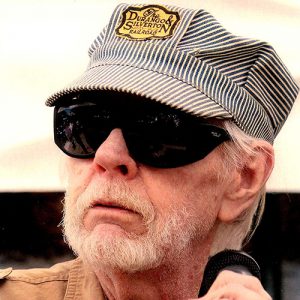
The rest of the players: Ryan, my brother; myself; Richard Ballantine, publisher of The Herald; and the man, the myth, the legend himself: Bill Dale Fries, aka C.W. McCall.
REMEMBER THAT TIME I MET C.W. McCALL?
By Aaron Unterreiner
To borrow a tease from Kari and Ryan that always got my goat as a youth, “Hey, do you remember that time?”
Of course, my older siblings had no particular time in mind, but with me none the wiser, they’d always pretend otherwise. They were the cool, really, really good-looking blonde and blond kids that always knew the inside joke, while I was the Alfred E. Newman-looking, red-headed stepchild that came from the mailman and always was on the wrong side of the jape. (No offense, Mom; kids can be cruel, especially siblings.)
This time, however, there is a time in mind. You could say it started in 1928. For Uncle Steve, it started in 1975. For the Boswells, it started in 1987. For me, it started in 1996: That was the time I first heard C.W. McCall sing … er, talk, er sing/talk.
C.W. McCall was born in 1928 – “born in Iowa, a flatlander; I always dreamed of the mountains, especially the Rockies,” he told me in 2012.
Uncle Steve first heard him in 1975, then introduced the legend to a legendary family – the Boswells. “They came out with some newfangled technology called cassette tapes, and I made a tape of C.W.’s greatest hits for our first-ever trip to Gulf Shores in 1987,” Steve said. “Kari, aka Betty Boswell, was about 15 years old at the time and fell in love with C.W. As I recall, she loved the line in the ‘Old Home Filler-Up an’ Keep On-a-Truckin’ Cafe’ song that said Mavis was built like a burlap bag full of bobcats. Kari would just laugh and giggle when she heard that line.”
Tried and true for the Boswells, the cassette tape turned into a compact disc and was passed on to Ryan and I in ’96 – by Uncle Steve en route to Gulf Shores at a gas station somewhere in the south that probably played “Convoy” on its own greatest hits compilation about 100 times a day.
“I remember looking in the rear-view mirror seeing all of you laughing at the music,” said Steve, who was leading our very own convoy to the beach that year. “I didn’t know whether you got a kick out of C.W. and his crazy songs or you were laughing at me for listening to that type of music. I just figured it was a little bit of both.”
OUR BIRTHRIGHT
Now, being born Unterreiner means the likes of Johnny Cash, Kris Kristofferson, and Tom T. Hall are more than just singers … er, talkers, er, singers/talkers. They’re the mixed tape first thing in the morning before a Saturday 10K; they’re the cool-down music on the way home; they’re the stewards over our dinner table; they’re the announcers over a familial game of 9-ball; they’re the whispers in the night, lulling us to sleep with their bedtime stories. We know this voice.
And then, there’s C.W. McCall. Honestly, when I first heard it, I didn’t know if it was serious or not; I didn’t know if I should laugh, cry, or cry from laughter. Turns out, it was a little bit of both.
I mean, how could you not cry after hearing “Roses for Mama,” a song so sweet it was remade three times – once into a movie, once in American song, once in German? Or how about “Aurora Borealis” – I mean, Joe had never even seen the Milky Way!? The poor guy thought those stars way out in the sticks were smog!
The funny is obvious, just one turn through a C.W. chorus with his lovely backup singers dropping that hook and, well, you’re hooked – hooked like the Billboard Hot 100, which featured four of C.W. McCall’s songs; hooked like Johnny Carson, who hosted C.W. McCall for an interview on his TV show on May 20, 1975; hooked like Uncle Steve; hooked like the Boswells.
At some point, I stopped laughing at the music and started singing with the music. Perhaps it was when McCall’s “mountains” became my mountains, too. I made the trek cross-country to Durango in 2004, and I saw C.W.’s truckers on their CB radios. I climbed “Wolf Creek Pass” – “way up on the Great Divide” – and fortunately I did not lose control on the descent and “slam into a feed store in downtown Pagosa Springs.” I now knew “Black Bear Road” and learned for myself why “you don’t have to be crazy to drive this road, but it helps,” and why unless we had drove the Black Bear Road before, we’d be, well, “we’d be better off to stay in bed an’ sleep late (now pay no ’tention to the guitar there).”
THE D&SNGRR
And when you live in Durango, you most certainly know of the Durango & Silverton Narrow Gauge Railroad – “here comes the Silverton up from Durango; here comes the Silverton a-shovelin’ coal; here comes the Silverton up from the canyon; see the smoke and hear the whistle blow!”
C.W. McCall lives in Ouray, like Durango, one of Southwest Colorado’s four mining towns, which he considers all “home.” For me, there’s nothing better than catching Cardinals baseball on opening day at Busch Stadium in St. Louis; for C.W., there’s nothing better than catching opening day of the D&SNGRR at the Durango trainyard. He never misses one.
But as of Friday, May 4, 2012, on opening day of the D&SNG, I didn’t know that. So, after eight years on the job at The Durango Herald, imagine my surprise when I walk into work for a typically well-built and heavily constructed Friday on the sports desk. Upon my arrival, I find my 66-year-old publisher running around the newsroom as giddy as a child on Christmas Eve, preparing for the any-minute-now arrival of the man, the legend, C.W. McCall.
I mean, the boss literally bounced through the front doors, around the reception desk, waving his arms above his head with a smile the size of Smelter Mountain. “C.W. McCALL IS HERE! C.W. McCALL IS HERE!”
At this point, I lost all professional discretion and threw my hat in the ring with the big guy. As far as I was concerned, it was Christmas Eve! I was that kid, dreaming of Santa’s sleigh flying over Germantown, Illinois, and Cape Girardeau, Missouri, landing on my grandmothers’ rooftops, delivering scooters with white T-bar grips and matching tires.
… oh my …
“C.W. McCALL IS HERE! C.W. McCALL IS HERE!”
Our photo editor tried to render “Convoy” on his iPhone, but it wasn’t loud enough. Our publisher wanted more; I wanted more. Rightfully so, he wanted it heralded off his Herald walls at a fever pitch, through the rafters, and out onto Main Street. Another colleague complied and blasted that ol’-timey music through his computer – C.W. McCall, loud and proud. And I started singing, like only a kid with a spatula for a microphone on Christmas Eve can.
Word for word.
Line for line.
Song for song.
The big man was impressed, so much so that his Smelter-sized smile even grew! (I’m hoping for a big raise at the turn of the next business year.) And my colleagues, well, I didn’t know whether they got a kick out of C.W. and his crazy songs or they were laughing at me for listening to that type of music. I just figured it was a little bit of both.
After I led the office through “Convoy” and “Wolf Creek Pass” – which checked in at Nos. 1 (1976) and 40 (1975) on the Billboard Hot 100, respectively – the man himself actually walked through our front doors.
“C.W. McCALL IS HERE! C.W. McCALL IS HERE!”
THE STORYTELLER
Now, Durango might be a small town, but it is beautiful, and beauty never falls short of suitors. This town has attracted its fair share of athletes. I’ve interviewed professional basketball players, Olympic and World Cup athletes, professional hockey players, and professional football players. I’ve interviewed Lance Armstrong, before his fall from grace. I’m not a class warrior. I’m not awestruck by fame or success. Some people make more money than others; some make less.
But when C.W. McCall walked into The Durango Herald that day, I knew … I was nervous! I hadn’t felt that in a long, long time. Then, I knew why. One of my favorite folksingers, Utah Phillips, another sing-song, talk-song kinda specialist, always asked of us: Whatever happened to kids actually believing in real-life heroes, not the Batmans, Ironmans, and Supermans, but real-life, flesh-and-blood heroes? I didn’t realize it until after I met C.W. McCall, but that’s why I was so nervous, that’s why I was so excited. I wasn’t so much nervous about meeting the man, I was nervous about meeting my heroes’ hero. This man meant something to me, my family, my dad, my uncles; if we’re talking currency, the only thing with real tangible value in my world is family.
An 84-year-old Bill Dale Fries – “pronounced fries, like the potato, not freeze,” he told us – walked into our newspaper wrapped in bewilderment, visibly crossing a threshold from comfortable (MC’ing opening day) to uncomfortable (MC’ing … what exactly?). Once upon a time, Bill Fries worked in newspapers as a political cartoonist, but that was a lifetime ago; Bill Fries wandered into our newspaper wondering what in the hell he was doing here. Of course, I was the first – well, second: After you, Mr. Publisher – to shake the man’s hand. Our born-again newspaper boss ushered Mr. McCall into a conference room, and we all followed suit like sheep to a flatlander farmer.
Apparently, nobody knew what came next. Our publisher was too damn giddy to say anything in the way of an introduction, so … Bill Dale Fries just started talking, telling his story. After working for his local newspaper as a teenager, Fries majored in music and fine arts at the University of Iowa. Upon graduating, he worked at an Omaha, Nebraska, television station, then as a sign painter.
“All that experience led me to get into advertising,” he said.
Fries quickly became art director of Bozell & Jacobs, an advertising agency in Omaha, when the Metz Baking Company asked him to design a television campaign for Old Home Bread, at which point I chimed in to answer the cacophony of bells ringing in my head. C.W. McCall was seated at the head of our daily news meeting table, a king at the head of our great hall; I was seated at his right. My king, dumbstruck that this mere child sitting next to him actually knew of which he spoke, fumbled for his words.
“Yeah, yeah, the ‘Old Home Filler-Up and Keep On-a-Truckin’ Cafe,’” I said. The look he gave me I will cherish forever. He was shocked – SHOCKED! – that this 20-something-year-old knew his music and knew it well! He went from uncomfortable to comfortable quicker than you could say “a burlap bag full of bobcats,” and whenever he stumbled upon his own history lesson next, he only needed to look right to find his answers. Me, C.W. McCall’s muse!
The long and short of his legend: He produced an ad that centered on the interaction between a wizened truck driver named C.W. McCall and the waitress named Mavis, but as Bill Fries tells it, the actor they found to play C.W. McCall “was a falsetto, and while he was plenty good-lookin’ enough, well, that hardly worked with my character!” So, the man, Bill Fries, was reborn as C.W. McCall, the legend, as the ad agency eventually suggested. They used the “plenty good-lookin’ enough” guy as the character in the commercial, but C.W. did the voiceover sure enough, and the legend was born.
“These commercials became a huge sensation in Iowa, Missouri – the whole region,” he said. “When we went to New York City for the Clio Awards, I’ll be damned if we didn’t win the top advertising campaign. We were competing with all these Madison Avenue types – the ‘Mad Men’ of that era. But we beat out Chrysler and Ford.”
The commercial also proved to be the springboard for Fries’ unlikely second career as a best-selling country musician, who toured the country singing his hits, such as the 1976 No. 1 chart-topper “Convoy,” which sold more than two million copies. Suddenly, he was getting calls from Capitol Records and MGM Records about doing an album.
“We need 10 more songs like these,” they told him.
“I … I … I’m still just an ad man,” he recalled thinking.
So he wrote another hit song, “Wolf Creek Pass.”
“We need 10 more songs like these,” they told him.
“I … I … I’m still just an ad man,” he said again.
So he wrote the “Old Home Filler-Up and Keep On-a-Truckin’ Cafe” and “There Won’t Be No Country Music (There Won’t Be No Rock ’n’ Roll)” – both reaching the Billboard Hot 100. He wrote “Round the World with the Rubber Duck” (“sequels are tough,” he turned and told me specifically when I boasted of knowing all about the lesser known “Convoy” reprisal). He wrote “The Silverton” and “Four Wheel Drive” and “Classified” and “Crispy Critters.”
“I wrote a lot of those songs about this area – Durango, Ouray, Silverton – and they caught on around the country,” the eventual mayor of Ouray said. “I don’t know why; people just identify with real, homespun stories, I guess.
“You have to be at the right place at the right time and the right place with the right stuff – that’s all a matter of chance,” he said. “But people tell me, ‘You’re so lucky,’ and I don’t go along with that. I think you make your own luck.”
JUST LIKE ELMO AND McCALL
Fortunately, C.W., we Unterreiners were all in the right place at the right time with the right stuff. Luck? I guess not. We know a good song when we hear it, especially our Uncle Steve, aka Bart Boswell, who needed to hear a good song every now and again as a reprieve from Big Bird’s “Easy Going.”
“David John loved it,” Kari said of the Boswells’ oldest child’s affection for the Sesame Street singalong. “The two of us would sing together from the back seat, over and over and over. Mark was too little to sing along, but he would bebop in his car seat feeling carefree and happy. We’d look up and see Debbie in smiles in the front, happy with life knowing that her kids were being soothed by the love of Big Bird in song. All was good.
“And then, you’d take a peek at Uncle Steve. He was dying up there, counting down the minutes until Elmo would take his friends and just GO AWAY! The music was not bringing him that easy-going feeling,” said Betty, the Boswells’ teenage babysitter during the early years of our family’s annual Gulf Shores vacations. “He was sick of the sing-song. He’d beg Debbie to put something else in.”
Hey, remember that time?
“A little C.W. … PLEASE!? Anything but this,” Betty remembered Bart saying. Eventually, Bart’s battle cry rubbed off on Beulah, Biff, Barney Big Belly, Baby, and Buford the Beatle Bug.
“When David and Mark were littler they would cry over this change in tune; however, as the years went on and this theme continues, even David and Mark and then John were happy to hear C.W. coming from the speakers,” Betty said.
Cries of tears turned to cries of joy for “REWIND THE TAPE!” – “so we could hear it over and over again. We would sing along and laugh and laugh as we drove our way to the beach,” Kari said. “Sometimes Steve would pretend to have a CB player, and he would call another truck driver.”
“Yeah, breaker 1-9, this here’s the Rubber Duck. You got a copy on me, Pig Pen? C’mon. Ah, yeah, 10-4, Pig Pen, for sure, for sure. By golly, it’s clean clear to Flag Town, c’mon. Yeah, that’s a big 10-4 there, Pig-Pen. Yeah, we definitely got the front door, good buddy. Mercy sakes alive, looks like we got us a convoy.”